|
 |
|
Home > Legislation > Industrial Property Code > Art. 101 - 200
INDUSTRIAL PROPERTY CODE[ Chinese Version ] [ Portuguese Version ]
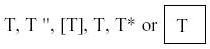
THE INDUSTRIAL PROPERTY CODESUB-SECTION IVEFFECTS OF THE PATENTArticle 101(Scope of protection)1. The scope of protection conferred by the patent shall be determined by the content of the claims, the description and the drawings serving for interpretation purposes. 2. If the subject matter of the patent concerns a process, the rights conferred by that patent shall include the products directly obtained by the patented process. 3. The protection conferred by a patent relating to a biological material endowed by the invention with certain properties shall extend to any biological material obtained from the said biological material by reproduction or multiplication, in identical or different form, and endowed with those same properties. 4. The protection conferred by a patent relating to a process for producing a biological material endowed by the invention with certain properties, shall extend to biological material directly obtained by that process and any other biological material obtained from the directly obtained biological material, by reproduction or multiplication, in ident ical or differentiated form, and endowed with those same properties. 5. The protection conferred by a patent relating to a product that contains genetic information or that consists in genetic information, shall extend to any material, subject to the provisions of article 62(3(a)), in which the product is incorporate and in which its function is contained and exercised. 6. Notwithstanding the provisions of paragraphs 3 to 5, the sale or any other form of commercialization by the patent-holder, or with his consent, to a farmer, of plant reproduction material, or breeding animals or other animal reproduction material, shall imply that the farmer has permission to use the protected animals, the animal reproduction material or the product of his harvest in order himself to proceed to reproduce or multiply animal or plant species exclusively for the purpose of his own agricultural exploitation. 7. Unless otherwise agreed by the parties, the permission referred to in the previous paragraph shall not entitle the farmer to exercise any reproductive activity for commercial purposes or as part of a commercial activity. Article 102(Inversion of the onus of proof)1. If the subject matter of a patent is a process for the manufacture of a new product, the same product manufactured by a third party shall, unless proven to the contrary, be deemed to be manufactured by the patented process. 2. When taking evidence, the court shall take account of the legitimate interest of the party bearing the burden of proof in preserving his trade secret. Article 103(Duration)1. The duration of the patent shall be 20 years from the date of the respective application. 2. Notwithstanding the provision for temporary protection, the exclusivity deriving from the patent pursuant to article 5 shall be effective only from the date of the granting of the respective certificate. Article 104(Rights conferred by the patent)1. Upon becoming valid, the patent shall confer on its holder: a) The exclusive right to exploit the invention in the Territory; b) The right to oppose any acts that constitute a breach of his patent, and specifically to prevent third parties, without his consent, from manufacturing, offering, storing, marketing or using a product covered by the patent, or importing or owning the same for any of the mentioned purposes. 2. The rights conferred by the patent may not exceed the scope defined for the claims. 3. The patent shall be granted with no guarantee as to the accuracy of the descriptions and its validity may not be presumed by virtue of the fact that the respective certificate was granted. Article 105(Limitation on the rights conferred by the patent)The rights conferred by the patent shall not include: a) The preparation of medicines made up on the spot and for individual cases by dispensing chemists on a medical prescription, nor acts relative to medicines so prepared; b) Acts performed exclusively for test or experimental purposes, including experiments in preparation for the administrative processes necessary for the approval of products by the relevant official bodies, because the industrial or commercial exploitation of those products cannot begin before checking whether the patent protecting them has lapsed; c) The use on board ships of other countries or territories members of the WTO or the Union of the subject matter of the patented invention in the body of the ship, in the machinery, in the masting, equipment and other accessories, when they temporarily or accidentally enter the waters of the Territory, inasmuch as the said invention is used exclusively for the needs of the ship; d) The use of the subject matter of the patented invention either in the construction or operation of air or land transport vehicles of other countries or territories members of the WTO or the Union or of accessories on those vehicles, when they temporarily or accidentally enter in the Territory; e) The acts envisaged in article 27 of the Convention of 7 December 1944 relative to International Civil Aviation, if these acts concern aircrafts of another State but to which the provisions of the said article apply; f) The acts performed in the context of private use, having no commercial purpose. Article 106(Non-contravention of the patent)1. The rights conferred by the patent shall not be deemed to have been convened by anyone who, in good faith, in the Territory and before the date of application or of priority, when claimed: a) Came to know of the invention by his own means; and b) Used it or made effective and serious preparations with a view to such use. 2. Anyone benefiting from the assumption of non-contravention shall bare the onus of proof of the situations foreseen in the previous paragraph. 3. Prior use or the preparations for such use, based on the disclosures referred to in article 68(1(a)) shall not detract from good faith. 4. In the cases envisaged in paragraph 1, the beneficiary shall be entitled to continue or to begin use of the invention, to the extent of his prior knowledge, for the purposes of his own enterprise, but may transmit it only together with the commercial establishment in which the invention is used. SUB-SECTION VUSE OF THE PATENTArticle 107(Indication of the patent)During the validity of the patent, the patent-holder may, on the products, use the word "patented", "patent Nº." or "Pat. Nº.", in Portuguese or also in Chinese. Article 108(Loss and expropriation of the patent)1. Anyone can be legally deprived of a patent who has to meet commitments contracted with another or who has had it expropriated for a public purpose. 2. Any patent can, on payment of compensation, be expropriated to be used for the public good if the need to disclose the invention or to make it available for use by public entities so demands. 3. The terms of the Statute of Expropriation for the Public Good, pursuant to Decree-Law no. 43/97/M, of October 20 1997 shall apply mutatis mutandis. Article 109(Mandatory licences - admissibility)By ruling of the Governor, mandatory non-exclusive licences can be granted for a certain patent in any of the following cases: a) No or inadequate exploitation of the patented invention; b) Interdependence of patents; c) For reasons of public interest. Article 110(Mandatory licences - general rules)1. Mandatory licences can be granted only when the potential licensee has made efforts to obtain a contractual licence from the patent-holder on acceptable commercial terms and such efforts have not been successful within a reasonable period. 2. While a mandatory licence is in force, the patent-holder cannot be compelled to grant another licence before the mandatory licence has been cancelled. 3. The holder of the patent for which a mandatory licence is issued shall be entitled to: a) An appropriate remuneration in each concrete case, bearing in mind the economic value of the licence; b) Request the judicial revision of the decision to grant or refuse such remuneration. 4. Mandatory licences may be assigned only with the part of the company or of the establishment that exploits them. 5. The title-holder of a patent in respect of which a mandatory licence has been issued shall, when granting the licence, provide the licensee with all the elements of a technical nature of which he is aware at that moment and that are necessary for the exploitation of the invention. Article 111(Mandatory licences issued in the case of no or inadequate exploitation of the patent)1. If a patent is not or is inadequately exploited, there shall lie grounds to apply for a mandatory licence if the patent-holder, without good or legal reason, by 4 years from the date of the patent application or 3 years from the date of the granting, whichever the longer: a) Has not begun exploitation or made effective preparations to that end, nor granted licences for the patented invention in the Territory or in any other country or territory member of WTO; b) Has not exploited the invention in such a way that the results satisfy the market requirements in the Territory. 2. Another ground for requesting a mandatory licence shall be the patent-holder's failing, without good legal reason, to exploit the invention, either in Macao or in any other country or territory member of WTO, during 3 consecutive years. 3. Good reasons shall be deemed to be objective difficulties of a technical or legal nature, independent of the will and situation of the patent-holder, that make it impossible to exploit or sufficiently exploit the invention, but not economic or financial difficulties. Article 112(Interdependent licences)1. When the exploitation of an invention protected by a patent is not possible without damaging the rights conferred by a prior patent, the mandatory licence may be granted only if the subsequent invention represents a notable technical progress over the prior invention. 2. Once the mandatory licence has been granted, either of the licence-holders shall be entitled to request a mandatory licence on the patent of the other. Article 113(Public interest)1. A mandatory licence for the exploitation of an invention can be granted in the public interest. 2. Public interest is deemed to obtain when the beginning, the increase or the generalization of the exploitation of the invention or the improvement of the conditions in which the invention is exploited are of primordial importance for public health or safety. Article 114(Application for mandatory licences)1. Application for the granting of a mandatory licence shall be filed with the DES, accompanied by the necessary elements proving the respective grounds. 2. Applications for mandatory licences shall be examined in the order in which they are filed with the DES. 3. Once the DES has received the application for a mandatory licence, it shall notify the patentholder in order that, within 2 months, he/it may state what he/it wishes to do, submitting the respective proof. 4. The DES shall then have 2 months to analyze the arguments advanced by the parties and the guarantees offered by the applicant for the mandatory licence that it will exploit the invention, to prepare the corresponding opinion and to submit the proceedings for the Governor's decision, which shall be handed down within 1 month. 5. When the mandatory licence application is based on the public interests referred to in the previous article, the process shall be submitted to the Governor's appreciation only after having obtained the opinion of the Science, Technology and Innovation Committee and, if applicable, of the Health Services of Macao or of the Directorate of the Macao Security Services, and after the title-holder has had a chance to take a stand on the tenor of those opinions. 6. The deadlines for the issue of the opinions and the patent-holder's answer, under the terms of the previous paragraph, shall be set by the DES at 1 to 3 months. 7. If the application is deferred, the DES shall appoint an expert and notify both parties in order that, within 1 month, they name their experts, it then being up to the three experts, within 2 months, to agree on the conditions of the mandatory licence and the remuneration to be paid to the patent-holder. Article 115(Cancellation and reappreciation of the mandatory licence)1. The mandatory licence can be cancelled if: a) The licensee does not abide by the conditions imposed on granting or the purposes for which it was granted; b) The circumstances on which the granting was based no longer obtain and are unlikely to be repeated. 2. The initiative to introduce proceedings to cancel the licence shall lie with the DES, with the patent-holder and, where applicable, with the other licensees. 3. The patent-holder shall be entitled, with good reason, to request the reappreciation of the conditions and circumstances under which the mandatory licence was granted. Article 116(Notification and appeal with respect to the granting, refusal or cancellation of licence)1. The DES shall notify the parties of the granting and respective exploitation conditions, as well as of the refusal or cancellation of the licence. 2. Appeal to the competent civil court shall, within 3 months of the date of the notification, lie against the decision by the Governor to grant, refuse or revoke the mandatory licence, or just against the conditions on which it was granted. 3. The granting shall take effect only after the decision has become final and has been registered by the DES and after proof of payment of the fees due have been produced, as if it were an ordinary licence. 4. An extract of the registration referred to in the previous paragraph shall be published in the Official Bulletin. Article 117(Public tender for the exploitation of an invention)1. A patent-holder, as indeed a patent applicant that has already complied with the obligation referred to in article 86(1) but has still not granted an exclusive licence to exploit the invention, may submit to the DES a written declaration by which he makes the exploitation of the invention available to third parties as non-exclusive licensees, gratuitously or for appropriate consideration. 2. If no agreement can be reached on the initial amount of the consideration, or on the terms according to which it should be altered if it has proven manifestly inadequate, it shall, if the parties so desire, be set by arbitration or by the court. 3. The party making the declaration may withdraw it at any time by submitting an application to the DES, but this cannot be used against persons whose agreement to exploit the invention has already been communicated to the applicant or patent-holder. 4. The declaration shall lapse on the right to the patent being recognized by a court decision as belonging to someone other than the party making the declaration. 5. Until such time as the declaration has been withdrawn or declared lapsed, the DES shall refuse entry in the register of any exclusive licences relating to the invention in question. 6. The DES shall not charge any fee for the publication of the public declaration of tender, nor for notices of the withdrawal or lapse thereof. 7. Until such time as the declaration has been withdrawn or declared lapsed, any fees that may be due for the patents or patent applications subject to public tender for exploitation shall be reduced or subject to exemption pursuant to the terms set in the ruling referred to article 42(2). SUB-SECTION VIEXPIRY OF THE PATENTArticle 118(Nullity of patents)Besides the general causes of nullity of industrial property rights foreseen in article 47, the following shall also constitute grounds for nullity of patents: a) The fact that the title or short title given to the invention includes different subject matter; b) The fact that the subject matter is not described in such a way as to allow the execution of the invention by a person skilled in the art; c) The extension of the subject matter of the patent beyond the content of the initial application. Article 119(Partial nullity or cancellation)1. One or more claims may be declared null or cancelled, but a claim cannot be decreed partially nullified or cancelled. 2. If a patent is declared nullified or partially nullified, it shall remain in force in its remaining parts whenever they can constitute subject matter of an independent patent. SECTION IIUTILITY MODELSArticle 120(Subject of protection)1. Under the present Statute, only inventions that so alter a subject matter as to give it a configuration, structure, mechanism or disposition that increases its utility or improves the advantage that can be derived therefrom can be protected as utility models,. 2. Inventions whose protection is applied for as a utility model shall meet the patentability requirements foreseen in the previous section, with the exception of those which are not compatible with their nature as referred to in the previous paragraph. 3. The applicant shall have the option, simultaneously or successively, of applying for an invention patent or a utility model for an invention that can be protected as a utility model. 4. The utility model shall cease to be effective once an invention patent has been granted for the same invention. Article 121(Duration and renewal)1. The duration of the utility model shall be 6 years from the date of submission of the application and shall be renewable for two additional periods of 2 years each. 2. The renewal request shall be submitted in the last 6 months of the current validity period. 3. The duration of the utility model cannot exceed 10 years from the date of presentation of the respective request. Article 122(Indication of the utility model)During the term of the patent, its holder may, on the products use the expressions referred to in article 107 or else the expressions, "Utility model No." or "Utility Mod. No.", in Portuguese or the equivalent in Chinese. Article 123(Fees due for the utility model)1. The fees due in respect of a utility model granting and revalidation procedure shall be those due for the corresponding acts in respect of an invention patent reduced by 40%. 2. The fees due for the renewal of a utility model shall be set in the ruling referred to in article 37(1). Article 124(Redemption)In all matters not contrary to the provisions of the present section, the provisions of the previous section shall apply to utility models, mutatis mutandis, and the examination report request or the documents in the stead thereof shall be submitted within 4 years of the date of the request. SECTION IIITHE COMPLEMENTARY CERTIFICATE FOR THE PROTECTION OF MEDICINES AND PHYTO-PHARMACEUTICAL PRODUCTSArticle 125(Certificate request)1. The application for a complementary protection certificate for medicines and for phytopharmaceutical products, hereinafter briefly called the complementary certificate, shall be made in writing in the official language of the Territory indicating the name or corporate style of the applicant, his/its nationality and domicile or location and shall be accompanied by the following items: a) The patent number and the title of the invention protected by that patent; b) The number and date of the first authorization to place the product on the market in Macao. 2. The application shall be accompanied by a copy of the first authorization to place the product on the market in Macao in order to identify the product, and which shall include the number and the date of the authorization as well as a summary of the characteristics of the product. Article 126(Examination and publication of the request)1. Once the application has been submitted to the DES, the respective formal examination is conducted in order to ensure that it was submitted within the deadline and that it meets the conditions set forth in the previous article. 2. If the application for a complementary certificate and the product in respect of which the application is being filed meet the conditions foreseen in the applicable law and those set in the present Statute, the DES will grant the complementary certificate and have the application published in the Official Bulletin. 3. If the application for a complementary certificate does not meet the conditions referred to in the previous paragraph, the DES will notify the applicant, requiring it within 2 months to rectify the irregularities or inadequacies found. 4. When, from the answer given by the applicant, the DES sees that the application for a complementary certificate meets the required conditions, it will have the application for the complementary certificate and the respective granting published in the Official Bulletin. 5. If the applicant does not comply with the notification mentioned in paragraph 3, the application will be refused and the application will be published in the Official Bulletin together with the refusal notice. 6. Notwithstanding the provisions of paragraph 3, the complementary certificate will be refused if the application or the product to which it refers does not meet the conditions foreseen in the present Statute and in any other applicable legislation and the application will be published in the Official Bulletin together with the refusal notice. 7. The publication shall comprise, at least, the following indications: a) The name and domicile or location of the applicant; b) The patent number; c) The title of the invention; d) The number and date of the authorization to place the product on the market in Macao, as well as identification of the product in respect of which the authorization was issued; e) The period of validity of the complementary certificate or the refusal notice, as appropriate. Article 127(Duration of the complementary certificate)The duration of the complementary certificate may not exceed by more than 7 years the term of the patent in respect of which is granted. Article 128(Extinction of the complementary certificate)The complementary certificate shall be declared null or expired, partially null or cancelled to the extent that the patent in respect of which it was issued be so declared. SECTION IVEXTENSION OF PATENTS GRANTED ABROADSUB-SECTION IEUROPEAN PATENTSArticle 129(Extension of European applications and patents)1. The applicant for a European patent and the holder of a European patent, processed according to the rules of the European Patent Convention, signed in Munich on 5 October 1963, may request the extension of the application or of the patent to Macao. 2. The DES shall publish extension applications in the Official Bulletin as soon as received from the European Patent Office, but never until 18 months have elapsed from the date the patent request was filed or, if a priority right be invoked, from the date of the first relevant application. 3. The extension applications may be freely withdrawn. Article 130(Effects of the European patent application)1. A regularly formulated European patent application shall in the Territory have the same legal effects as a Macao patent application, including with respect to priority rights. 2. The European patent shall be guaranteed the temporary protection foreseen in article 7 from the date the DES makes accessible to the public a translation of the respective claims in one of the official languages of the Territory, accompanied by a copy of the drawings. 3. The DES shall, after the party concerned has submitted the items referred to in the previous paragraph, proceed to publish the extension notice in the Official Bulletin. 4. From the date of publication of the notice referred to in the previous paragraph, anyone may take cognizance of the text of the translation and obtain reproductions thereof. Article 131(Effects of the European patent)1. A European patent extended to Macao shall have the same legal effects as a patent granted in Macao starting from the date of granting by the European Patent Office, provided that the formalities foreseen in the present article are observed. 2. Within 3 months following the publication of the notice of the granting of the patent in the European Patent Bulletin, the patent- holder shall provide the DES with a translation, in one of the official languages of the Territory, of the title or short title briefly describing the subject matter of the invention, the description of the subject matter of the invention and the claims and shall pay the relative fee for publication in the Official Bulletin. 3. If, during the course of the opposition phase, any modification is found in the elements referred to in the previous paragraph, the patent-holder shall, within 3 months from the date of the corresponding publication in the European Patent Bulletin: a) Provide the DES with the translation of such modifications in one of the official languages of the Territory; b) Pay the relevant fee for publication in the Official Bulletin. 4. The DES shall then, as soon as possible, publish the extension notice in the Official Bulletin together with the translations submitted in compliance with paragraphs 2 and 3. 5. The patent extension application shall be declared null and void if the necessary translations are not provided or the fees due not paid within the set deadline. 6. If the European patent be declared null, partially null or cancelled by the European Patent Office, in accordance with the applicable procedures, the respective extension to Macao shall also be invalidated. Article 132(Original text and translations)1. If the applicant or the holder of a European patent has neither domicile nor registered office in Macao, the translations of the texts shall be done under the responsibility of an authorized or accredited official agent or an agent registered with the DES. 2. When a translation has been submitted in one of the official languages of the Territory in accordance with the terms of the preceding articles, that translation shall be considered authentic if the European application or patent, in the translated text, provides a lesser degree of protection than that conferred by the same application or patent in the language used in the proceedings. 3. If the translation published in the Official Bulletin is republished because of some error therein, anyone who, in good faith, may have exploited the invention or made serious preparations to that end without violating the claims in the patent application or patent being corrected, may benefit from the provisions of article 106.. 4. The revision of the translation shall become effective only from the moment in which it is made accessible to the public by the DES and the respective fee has been paid. Article 133(Prohibition of dual protection)1. A Macao patent the subject matter of which is an invention for which a European patent has already been granted to the same inventor, or with his consent, with the same date of filing or priority, shall cease to have effect as from: a) The date on which the time limit for filing oppositions against the European patent expires, provide no opposition has been filed; b) The termination of opposition proceedings, if the European patent is upheld. 2. If the Macao patent is granted after either of the dates indicated in sub-paragraphs (a) and (b) of the previous paragraph, it shall not take effect and the relevant notice shall be published in the Official Bulletin. 3. The subsequent termination of the European patent shall not affect the provisions of the previous paragraphs. Article 134(Extension and renewal fees)1. The extension of a patent application or of a patent under the terms of the present section shall be subject to the payment of an extension fee to be paid to the European Patent Office in the deadlines and on the terms set in the European Patent Convention. 2. For all the European patents extended to Macao, the renewal fees applicable to Macao patents shall be due within the deadlines set in the present Statute. SUB-SECTION IIOTHER PATENTSArticle 135(Redemption)The provisions of the previous sub-section shall apply accordingly to patent applications filed with other designated entities in respect of article 85, as well as to the patents granted by those entities. CHAPTER IISEMICONDUCTOR TOPOGRAPHY PRODUCTSSECTION ISUBJECT MATTER OF PROTECTIONArticle 136(Subject matter of protection)1. Under the present Statute only the topographies of semiconductor products resulting from the intellectual effort of the creator and not known in the semiconductors industry can be protected by the granting of a topography registration certificate. 2. Likewise, topographies that comprise elements known in the semiconductor industry and the combination of whose elements taken together meet the conditions envisaged in the previous sub-paragraph shall also enjoy legal protection. 3. The protection shall cover only the configuration of electronic circuits, to the exclusion of any idea, process, system, technique or codified information incorporate into the topography. Article 137(Definition of semiconductor product)For the purposes of the protection conferred by the present Statute, a semiconductor product shall be understood as being the final or intermediate form of any product that, cumulatively: a) Consists of a material body that includes a layer of semiconductor material; b) Possesses one or more layers composed of conductive, insulating or semiconducting material, the layers being disposed in accordance with a predetermined three-dimensional model; c) Is designed to carry out an electronic function either alone or together with other functions. Article 138(Definition of semiconductor product topography)The topography of a semiconductor product is the group of related images, either fixed or codified, represented by the three-dimensional layout of the layers of which the product is composed, and in which each image has the layout or part of the layout of a surface of the same product, in any phase of its manufacture. SECTION IIOTHER PROVISIONSArticle 139(Temporary limitations on the exercise of the right) The right to register a semiconductor product topography cannot be exercised if: a) 2 years have already elapsed since the first commercial exploitation of the topography anywhere; b) 15 years have already elapsed since the topography was fixed or codified for the first time, if it was never exploited. Article 140(Additional elements of the application)In addition to the other elements required, the applicant to register a topography shall also indicate in the application: a) The date on which the topography was fixed or codified for the first time; b) Whether the topography has already been commercially exploited and, if so, the date on which that exploitation began. Article 141(Grounds for refusing to register a topography)1. A topography registration application shall be refused when: a) Any of the general grounds for refusing the granting of industrial property rights is found as referred to in article 9(1); b) The application is not filed in good time, in breach of the deadlines set in article 139. 2. The grounds for refusal referred to in article 9(1) may be used against the applicant only if it is apparent from the examination report that the topography cannot be registered, or if it was not possible to reach any conclusion on whether it could be registered because the items filed with the application did not permit any conclusion to be reached because they were inadequate, irregular, contradictory or confused. Article 142(Duration)The registration shall last 10 years from the date of the respective application or from the date on which the topography was exploited for the first time anywhere, whichever the sooner. Article 143(Rights conferred by registration)1. The registration of the topography shall confer on the holder the right to make exclusive use of the topography throughout the Territory by producing, manufacturing, selling or exploiting it or the items in which it is applied, together with the obligation to do so effectively and in keeping with the needs of the market. 2. The registration of the topography shall furthermore confer on the holder the right to authorize or to prohibit any of the following acts: a) The reproduction of the protected topography; b) The import, sale or distribution in any other form for commercial purposes of a protected topography, of a semiconductor product into which is incorporated a protected topography, or an article into which is incorporated a semiconductor product of that type, to the extent and only to the extent that it continues to include a topography reproduced illegally. Article 144(Limitation on the rights conferred by the registration)1. The rights conferred by the registration of the topography shall not include: a) The private reproduction of a topography for non-commercial purposes; b) Reproduction for the purpose of analysis, evaluation or teaching; c) The creation of a different topography, starting from the analysis or evaluation referred to in the previous sub-paragraph, that could in turn benefit from the protection foreseen in the present Statute; d) The performance of any of the acts referred to in article 143(2), in relation to a semiconductor product in which is incorporate an illegally reproduced topography or any article in which is incorporate a semiconductor product of that type, if the person that performed or ordered the performance of those acts neither knew nor should have known on acquiring the semiconductor product or the article into which that semiconductor product was incorporated, that the said article incorporated an illegally reproduced topography. 2. Once the person referred to in sub-paragraph 1(d) has received enough information to indicate that the topography was reproduced illegally, that person can perform any of the acts in question in relation to the products in his possession or ordered up to that moment, but must pay the holder of the registration an amount equivalent to an appropriate royalty such as could be demanded under the protection of a licence freely negotiated in relation to a topography of that type. Article 145(Indication of the registration)During the validity of the registration, the holder may mark semiconductor products manufactured by the use of protected topographies with a capital letter "T", in one of the following forms:
Article 146(Mandatory exploitation licence)The provisions of articles 109 to 116 shall apply to the topographies of semiconductor products only when the mandatory licences have a public, non-commercial purpose. Article 147(Nullity of the topography registration)In addition to the general causes of nullity of industrial property rights foreseen in article 47, semiconductor product topographies registrations may also be declared null and void because: a) The title or short title given to the invention includes different subject matter; b) The subject matter is not described in such a way as to permit the execution of the topography by a person skilled in the art; c) The subject matter of the registration extends beyond the content of the initial application. Article 148(Partial nullity or cancellation)1. One or more claims may be declared null or cancelled, but a claim cannot be decreed partially nullified or cancelled. 2. If a topography registration is declared nullified or partially nullified, it shall remain in force in its remaining parts whenever they can constitute subject matter of an independent topography registration. Article 149(Referral)Provided that they are not incompatible with the nature of semiconductor product topographies, the provisions of section I of the previous chapter shall apply thereto, with the special considerations set forth in the present chapter. CHAPTER IIIINDUSTRIAL MODELS AND DESIGNSSECTION ISUBJECT MATTER OF PROTECTIONArticle 150(Subject matter of protection)Subject matter that may be protected under the present Statute, by the registration of an industrial model or design shall be limited to creations whose appearance represents a product in whole or in part by virtue of such characteristics as lines, contours, colours, forms, textures and/or the materials used in the product itself and/or its ornamentation and which meet the requirements set forth in the present section. Article 151(Product definition)1. For the purposes of the previous article, a product shall be considered any industrial or crafted article, including, inter alia, the components for assembling a complex product, the packing, the presentation elements, the graphic symbols and the typographic characters, but excluding computer programs. 2. By complex product shall be understood any article composed of multiple components which can be removed therefrom for the purpose of stripping it and inserted into it for the purpose of reassembling it. Article 152(Requirements for registration)1. Industrial models and designs may be registered which: a) Are novel; b) Are unique. 2. The innovative nature of the industrial model or design shall not be diminished if, although not entirely novel, it involves novel combinations of known elements or a different layout of already used elements, that endow the respective subject matter with a unique character. Article 153(Novelty)1. The industrial model or design shall be considered novel if, prior to the respective registration or priority application, no identical industrial model or design was published within or outside the Territory. 2. Industrial models or designs that differ only in insignificant details shall be considered identical. Article 154(Unique character)1. An industrial model or design shall be considered to be unique in character if the global impression that it gives to the informed user differs from the global impression caused that user by any industrial model or design published prior to the date of the registration application or claimed priority. 2. In appreciating the uniqueness of the character, account shall be taken of the degree of freedom that the creator had to create the industrial model or design. Article 155(Industrial models or designs incorporated into components)1. An industrial model or design applied to or incorporated into a product that constitutes a component of a complex product shall be considered novel and unique in character: a) If it can reasonably be considered that even after being incorporated into the complex product, it will continue to be visible during the normal use of the complex product; and b) To the extent that the visible characteristics of that component itself meets the requirements of novelty and uniqueness of character. 2. For the purposes of the provision in sub-paragraph (a) above, normal use shall be understood as any use different from conservation, maintenance or repair. Article 156(Exceptions to and limitations on registration)1. Registration shall not protect: a) The visible characteristics of a product resulting exclusively from its technical function; and b) The visible characteristics of a product that must necessarily be reproduced in its exact form and dimensions so that the product into which the industrial model or design is to be incorporated, or in which it is applied, be it mechanically connected to the other product, or be it inserted within, around or against that other product, can both perform their function. 2. Notwithstanding the provision of sub-paragraph (b) above and provided that the requirements of innovation and uniqueness have been met, the registration of an industrial model or design is possible if its purpose is to permit a multiple assembly of interchangeable products or their interconnection to form a modular system. Article 157(Disclosure)1. For the purposes of articles 153 and 155, an industrial model or design shall be considered to have been disclosed if it has been published, presented in an exhibition, used in trade or made known in any other way, except if these facts could not reasonably have come to the knowledge of persons operating in Macao and skilled in the art in question in the course of their normal activity, before the date of filing of the registration application or priority claim. 2. The industrial model or design shall, however, not be considered disclosed by the simple fact of being made know to a third party in explicit or implicit confidence. Article 158(Non-opposable disclosures)1. For the purposes of articles 153 and 155, no account shall be taken of any disclosure if the industrial model or design for which registration is sought was disclosed: a) By the creator, by his successor or by a third party, as the result of information they provided or measures they took; b) At an official or officially recognized international exhibition under the terms of the Convention relating to International Exhibitions, signed in Paris on 22 November 1928, at Portuguese or official international courses, exhibitions and fairs, or those officially recognized in any of the countries or territories members of WTO or of the Union during the 12 months preceding the date of filing of the registration application or, where a priority is being claimed, on the priority date; c) As the result of an abuse of the creator or his successor. 2. Proof of the non-opposability of the disclosure, pursuant to sub-paragraphs (a) and (b) above, shall be brought by the applicant within 3 months from the date of filing of the registration application. SECTION IIRIGHT TO REGISTER INDUSTRIAL MODELS AND DESIGNSArticle 159(Right to register)1. The right to register shall lie with the creator or his successors in any capacity. 2. Notwithstanding the provisions governing copyright, the provisions of articles 70 to 76 shall apply to the registration of industrial models or designs. SECTION IIITHE REGISTRATION PROCEDURE FOR INDUSTRIAL MODELS AND DESIGNSArticle 160(Form of application)1. The application to register an industrial model or design shall be filed in writing in an official language of the Territory, indicating the name or commercial style of the applicant, his/its nationality and domicile or location and shall be accompanied by the following items, in triplicate: a) The title or short title designating the industrial model or design that it is wished to register or the purpose for which it is intended, as appropriate; b) The name and country or territory in which the creator resides; c) A photolithograph or any other medium that may be demanded by the DES, bearing a reproduction of the object whose industrial model or design it is wished to register; d) The priority right claim, if applicable, pursuant to article 17(3). 2. Fantasy expressions used to designate the industrial model or design shall not constitute subject matter for protection. Article 161(Complementary elements of the application)1. The application for the registration of industrial models or designs should be accompanied by the following items: a) A description of the innovative characteristic attributed to the subject matter whose industrial model or design it is wished to register; b) Drawings or photographs of the said subject matter; 2. If appropriate, the registration application shall further be accompanied by: a) The request for stay of publication of the application; b) The document proving authorization of the holder's copyright when the industrial model or design was reproduced from a work of art not in the public domain or, in general, of the copyright of the actual author, if he is not the applicant; c) The documents proving the priority right claimed. 3. The description of the novel characteristics attributed to the subject matter whose industrial model or design it is wished to register shall be written on the applicant's own printed paper, containing a detailed explanation of the geometric or ornamental aspect of the subject matter and should preferably not contain more than 150 words or 400 characters. 4. The DES can request or the applicant may of his own initiative submit the actual subject matter or other perspective photographs that help to form a more exact idea of the industrial model or design. 5. In applications for the registration of a design, when a combination of colours is claimed, the drawings or pictures shall show the colours claimed. 6. The stay of the publication referred to in sub-paragraph 2(a) shall not exceed 30 months from the filing date of the application or claimed priority. Article 162(Unity of application and of registration of industrial model or design)1. The same application cannot request more than one registration and each industrial model or design shall form the subject matter of a separate registration. 2. Industrial models or designs that constitute the various indispensable parts to form a whole shall be included in a single registration. Article 163(Multiple applications)1. Notwithstanding the provisions of the previous article, industrial models or designs that possess the same preponderant distinctive characteristics may be included in a single registration, up to a maximum of 10, in such a way as to constitute a group of interrelated objects for the purpose of their use or application. 2. In the case referred to in the previous paragraph, the group shall constitute an indissociable whole, resulting in a single registration that cannot be separately or partially assigned. 3. The drawings or photographs of the industrial models or designs referred to in paragraph 1 above shall be numbered sequentially, in accordance with the total number of objects that it is wished to include in the same application. Article 164(Examination as to form)1. Once the application has been received, the DES will proceed to its formal examination within 1 month, to verify that it complies with the requirements of articles 160 to 163. 2. If the application lacks any of the required items, or should any of them not be in order, the applicant shall rectify that situation within 2 months from the notification that the DES will send it to that effect or, where no such notification is given, within a maximum of 3 months from the filing of the application, both of which deadlines may be extended by 1 additional month, on a founded request. 3. Article 82(3) to (6) shall apply accordingly. 4. If the applicant fails to rectify the irregularities referred to within the set deadline, the application shall be refused and the respective notice published in the Official Bulletin. Article 165(Notice of public disclosure)1. Once 12 months have elapsed from the date of filing the application or, if a priority right was claimed, from the claimed date, the DES will have the disclosure notice published in the Official Bulletin and the application proceedings shall be available to the public from that date. 2. The proceedings may be published before the end of the period referred to in the previous paragraph, if the applicant so requests, and provided that: a) At least 2 months have elapsed since the filing of the registration application; b) The application is not pending rectification, as indicated in the previous article; c) The early publication fee has been paid. Article 166(Opposition)1. Starting from the publication of the disclosure notice, and up to the date the registration is granted, any third party may approach the DES, in writing, opposing the registration of the industrial model or design in respect of which the application was filed. 2. The oppositions shall be transmitted to the applicant, who may respond within 2 months from the notification of such opposition. Article 167(Examination report and designated entities)1. The examination report on the industrial model or design, to be compiled by one of the designated entities, shall be based on a reproduction of the subject matter whose industrial model or design it is wished to register, or pictures or drawings thereof or the subject matter itself, if appropriate, and its purpose shall be to appreciate whether it meets the requirements for registration. 2. Article 85(2) and (3) shall apply accordingly. Article 168(Examination of the industrial model or design)The provisions of article 86 shall apply accordingly to industrial models and designs, except for the deadline by which some of the elements should be submitted as referred to in paragraph 1 thereof, which shall be 30 months. Article 169(Request for examination report by third parties)1. Starting from the date of public disclosure of the registration application proceedings, anyone may request the conduct of the examination report referred to in the previous article, if the applicant has not yet done so, up to 30 months from the date of filing of the registration application. 2. Article 87(2) shall apply accordingly. Article 170(Rejection of the examination request and amendments - renunciation)The provisions of articles 88 and 89 shall, mutatis mutandis, apply to industrial models and designs. Article 171(Rectification following the examination report)1. If the designated entity does not follow up on the examination report, the DES shall transmit this decision to the applicant and this notification shall substitute the examination report for purpose of granting the registration. 2. The DES shall also inform the applicant of the impossibility of producing the examination report when the designated entity considers that: a) The description, drawings, photographs and other similar elements do not meet the established requirements, so that it cannot conduct a substantial search; b) The subject matter of the registration application is such as not to fall within the category of an industrial model or design capable of being registered, or that it is not obliged, for other reasons, to proceed with the search. 3. In the case referred to in the previous paragraph, the applicant shall have a 2 month deadline in which to rectify the deficiencies in the registration application, and to reapply for the examination report. 4. If, after reapplying for the examination report, the designated entity reiterates that it is not able to change its conclusion with respect to the registration application that has been rectified, the applicant may submit a founded objection. 5. The objection referred to in the previous paragraph shall not be admitted if it has been shown that the industrial model or design could not be registered or if it is not submitted in the deadline set for the purpose by the DES or, where no such deadline was set, by the end of the period referred to article 169(1). Article 172(Divisible applications, multiple priorities and withdrawal of application - renunciation)The provisions of articles 91 to 93 and 96 shall apply, mutatis mutandis to industrial models and designs. Article 173(Grounds for refusing to register a de sign or model)The registration of a design or model shall be refused when: a) Any of the general grounds for refusal to grant industrial property rights obtains pursuant to article 9(1); b) A distinctive sign is used where there exist legal provisions conferring the right to prohibit the use thereof in the industrial model or design; c) The industrial model or design constitutes an unauthorized use of a work protected by copyright; d) The industrial model or design constitutes an improper use of any of the elements enumerated in article 6ter of the Paris Convention for the Protection of Industrial Property, or of any other badges, emblems and hallmarks not included in that Convention but that are of particular public interest to the Territory. Article 174(Partial granting)1. If it is just a question of deleting sentences from the description, altering the title or short title, or removing some of the subject matter from the application itself to comply with the notification, the DES may effect such amendments and have the application granting notice published in the Official Bulletin if the applicant does not expressly raise any opposition within 1 month of the said notification. 2. The publication of the notice mentioned in the previous paragraph, with the transcription of the abstract shall indicate the amendments made. Article 175(Notification of granting or refusal of registration)The granting or refusal of the registration shall be notified pursuant to article 20(2) and (3) and published in the Official Bulletin. SECTION IVTHE EFFECTS OF REGISTRATION OF INDUSTRIAL MODELS AND DESIGNSArticle 176(Duration)1. The duration of the registration shall be 5 years from the date of the application, renewable for like periods up to the 25 year limit. 2. Renewals as referred to in the previous paragraph shall be requested during the last 6 months of validity of the registration. Article 177(Rights conferred by registration)1. Once valid, the registration of an industrial model or design shall confer on its holder the exclusive right to use the model or design and to prohibit its use by third parties without his consent. 2. The use referred to in the previous paragraph shall include, especially, the offering, placing on the market, import, export or use of a product into which that industrial model or design is incorporated, or to which it is applied, as well as the storage of that product for the same ends. 3. The validity of the registration shall not be presumed from the act the granting the respective certificate. Article 178(Limitation on the rights conferred by the registration)The rights conferred by the registration shall not include: a) Acts for experimental purposes; b) Acts of reproduction for reference or for educational purposes, provided that they are compatible with fair trading practices, do not unduly prejudice the normal exploitation of the industrial model or design and mention the source; c) Equipment on board ships and aircraft registered in another country or territory, when they transit temporarily through the Territory; d) The import of spare parts and accessories for repairing the ships and aircraft referred to in the previous sub-paragraph, as well as the performance of such repairs; e) Acts performed in the private sphere, with no commercial purpose. Article 179(Relationship with copyrights)The effects of the registration of the industrial model or design shall not prejudice the protection conferred by copyright law from the date on which the industrial model or design was created or defined in any form. SECTION VTHE USE OF DRAWINGS AND MODELSArticle 180(Indication of the industrial model or design)During the validity of the registration its holder may, on the products, use the expression "design or model No.", or the abbreviations " D M No.", in Portuguese or else the equivalent Chinese expression (...). Article 181(Inalterability of the designs or models)1. For as long as the registration remains in effect, the designs or models shall be considered inalterable. 2. The enlargement or reduction of the scale shall not affect the inalterability of the designs or models. Article 182(Alterations of details of drawings or models)1. One or more new registrations may be made of amendments made by the holder of the registration to the drawings or models that merely alter details of little importance. 2. The registration or registrations referred to in the previous paragraph shall be annotated on the initial certificate and on all the registration certificates acquired under the same provision. 3. Drawings and models modified under the terms of the present article shall fall into the public domain on termination of the validity of the respective registration. SECTION VIEXPIRY OF REGISTRATION OF INDUSTRIAL MODELS AND DESIGNSArticle 183(Nullity of the registration of industrial models or designs)Besides the general causes of nullity of industrial property rights foreseen in article 47, a further cause of nullity of the registration of an industrial model or design shall be the fact that it is identical to a previous design or model, disclosed after the date of the registration or priority application, and which is protected from a prior date. Article 184(Nullity of the registration of designs or models)Registrations of designs or models may be cancelled in the cases foreseen in article 48 and, moreover, when: a) A distinctive sign is used in a subsequent design or model and the provisions regulating that sign confer the right to prohibit such use; b) The industrial model or design constitutes an unauthorized use of a work protected by copyrights; c) The industrial model or design constitutes an improper use of any of the elements enumerated in article 6ter of the Paris Convention for the Protection of Industrial Property, or of other badges, emblems and hallmarks not included in article 6ter of the said Convention that are of particular public interest in Macao. Article 185(Design or model registration refused, declared null or cancelled)1. If the registration of an industrial model or design has been refused under article 9(1(a)) or article 173(b), or declared null or cancelled, it can nevertheless still be registered, or the respective right maintained in an altered form, provided that: a) Its identity be maintained; and b) The necessary alterations be made in such a way as to meet the requirements of the present chapter. 2. The registration or maintenance in an altered form referred to in the previous paragraph may include the registration application accompanied by a declaration whereby the holder partially renounces the right to the industrial model or design, or the annotation in the respective proceedings of a court decision whereby the partial nullity of the right to the industrial model or design is declared. SECTION VIIPRIOR PROTECTION OF INDUSTRIAL MODELS AND DESIGNSArticle 186(Subject matter of the application for prior protection)An application for prior protection may be filed in respect of industrial models or designs of textile or clothing, as well as those of any other industries specified by an administrative ruling. Article 187(Deposit of samples or reproductions)1. The application for prior protection referred to in the previous article shall be preceded by the lodging of the respective samples or reproductions. 2. The DES may conclude protocols with suitable entities for the purposes envisaged in the previous paragraph. 3. The prior protection application shall be filed with the DES within 15 days of such lodging, it being possible to extended this deadline, for an equal period, for a justified reason worthy of consideration. Article 188(Secrecy and archiving)1. The samples or reproductions referred to in the previous article shall be kept secret during the period of validity of prior protection and archived beyond that period of validity. 2. In case of conflict as regards priorities in requests of previous protection, account shall be taken of the date on which the sample was deposited. Article 189(Form of application for prior protection)1. The application for prior protection for an industrial model or design shall be filed in writing in an official language of the Territory, indicating the name or commercial style of the applicant, his/its nationality and domicile or location, and shall be accompanied by the following elements: a) The number of samples or reproductions to be registered, up to a maximum of 50; b) The title or short title that synthesizes the subject matter or matters for which protection is being claimed or the purpose of such subject matter; c) The name and country or territory of residence of the creator's. 2. Fantasy expressions used to designate the industrial model or design shall not be subject matter subject to protection. Article 190(Proof of deposit of samples)The application for prior protection shall be accompanied by a certificate issued by the entities referred to in article 187(2), which identifies the applicant, indicates the date of reception of the samples or reproductions and the number allocated to the deposit. Article 191(Duration of prior protection)Prior protection shall obtain for 3 months from the date the respective application reaches the DES. Article 192(Rights conferred)Prior protection shall confer a priority right for the purposes of any registration application pursuant to the terms of articles 160 et seq. Article 193(Lapse of prior protection)Prior protection shall lapse in the period foreseen in article 191 or when application is filed to register any of the models or designs covered by that prior protection, under the terms of articles 160 et seq. Article 194(Conversion of the prior protection application)During the prior protection period, the applicant may at any time begin the registration process provided for in article[s] 160 [et seq] for the same designs or models for which the prior protection application was made. Article 195(Registration application for administrative acts or court action)If the applicant for prior protection intends to intervene in the administrative proceedings against the granting of registration or if he intends to take legal action on the industrial model or design, he shall file with the DES for a registration and examination application pursuant to articles 167 and 168. Article 196(Fees)1. A fee, set for the purpose, shall be due in respect of each application for prior protection and according to the number of samples or reproductions that it contains. 2. Failure to pay the fees referred to in the previous sub-paragraph shall render the prior protection application irreceivable. CHAPTER IVTRADEMARKSSECTION ISUBJECT MATTER OF PROTECTIONArticle 197(Subject matter of the trademark)The present Statute can afford protection as a trademark only to a sign or group of signs which are capable of being represented graphically, namely words, including personal names, designs, letters, numerals, sounds, the shape of the product or its packaging, and which are capable of distinguishing the products or services of one company from those of other companies. Article 198(Linguistic requirements)1. Wording contained in trademarks shall be written in Portuguese, Chinese or English, and may combine elements of these different languages. 2. The trademarks of products destined solely for export can be written in any language, but their use in Macao shall determine when they lapse. 3. The compulsory nature of the use of Portuguese, Chinese or English shall not apply to applications for the registration of international marks, under the terms of the respective regulation, and to marks whose applicant is not domiciled, headquartered or established in the Territory. Article 199(Exceptions and limitations to protection)1. Protection may not be afforded: a) Signs that consist exclusively in the shape resulting from the nature of the product itself, the shape of the product necessary for obtaining a technical result or the shape that gives the product its own substantial value; b) Signs or indications that may be used commercially to designate the kind, quality, quantity, purpose, value, geographical origin or time of production of the product or of the rendering of the service, or other characteristics thereof; c) Signs or indications that have become customary in current language or in bona fide and established commercial practices; d) Colours, except where they are combined together or used with graphics, wording or other elements in a particular and distinctive manner. 2. The generic elements mentioned in sub-paragraphs (b) and (c) of the preceding paragraph that constitute part of a trademark shall not be for the exclusive use of the applicant, unless the signs have acquired distinctive character in commercial practice. 3. On the request of the applicant or claimant, the DES shall, in handing down its ruling, indicate which of the constituent elements of the trademark are not for the exclusive use of the applicant. Article 200(Collective trademark)1. Notwithstanding the provisions of the previous article, trademarks may be protected as a collective trademark, according to the conditions pertaining to association marks or certification marks. 2. The registration of a collective trademark shall give its holder the right to control the marketing of the respective products or services, on the terms stipulated by law or in the statutes. 3. For the purpose of the present Statute, the following shall apply: a) Association Mark: a specific sign belonging to an association of individuals and/or bodies corporate, whose members use or have the intention of using the sign for products or services; b) Certification Mark: a specific sign belonging to a corporate entity that controls the products or services or establishes the regulations with which they must comply and that is to be used on the products or services subjected to that control or for which the regulations were established. 4. The provisions of the present Statute relating to product and service marks shall apply mutatis mutandis to collective marks.
[ Chinese Version ] [ Portuguese Version ] |
Printing Bureau (Macao SAR)
Rua da Imprensa Nacional, s/n - Macau
Phone: (853) 2857 3822 - Fax: (853) 2859 6802
Email: info@imprensa.macau.gov.mo